| Comparison Dimension | M42 (Bimetal Blade Tooth Material) | M51 (Bimetal Blade Tooth Material) |
|---|---|---|
| Cobalt (Co) content | Approx. 8% | Approx. 10% |
| Typical tooth-tip hardness | 67–69 HRC | 68–70 HRC |
| Reference max material hardness | ≤ 45 HRC (depending on conditions) | ≤ 50 HRC (depending on conditions) |
| Hot hardness (red hardness) | Begins losing hardness around 600°C | Softening window shifts significantly higher |
| Key advantage | Strong versatility, better impact toughness | Better wear resistance under sustained high temperature |
| Typical target conditions | Carbon steel, structural steel, aluminum, mixed stock, intermittent cutting | Austenitic stainless steel, high-alloy steel, titanium alloys, continuous high-speed production cutting |
| Relative cost | Baseline | Higher than M42 |
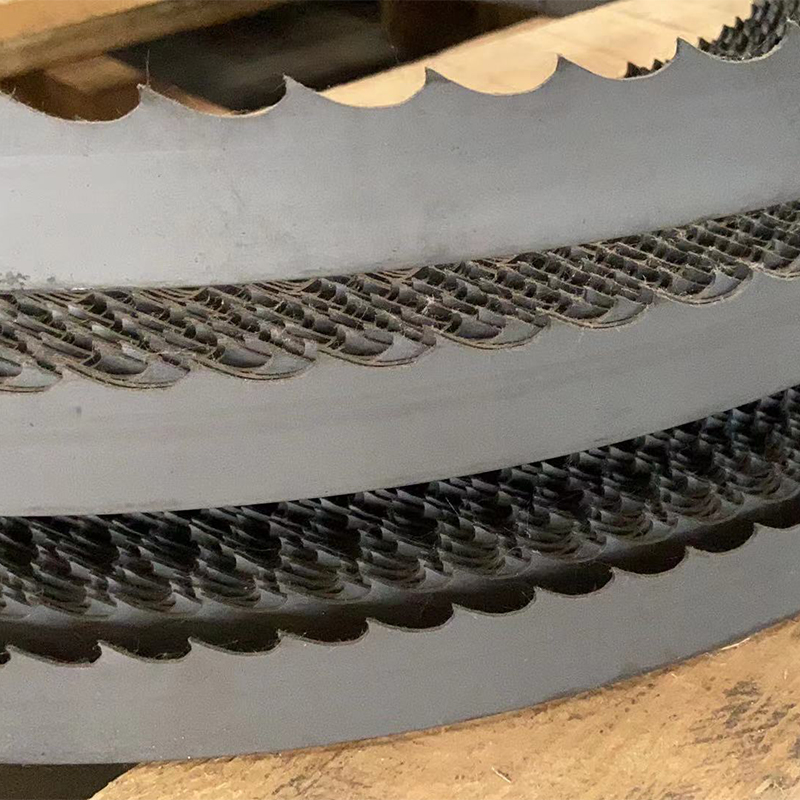
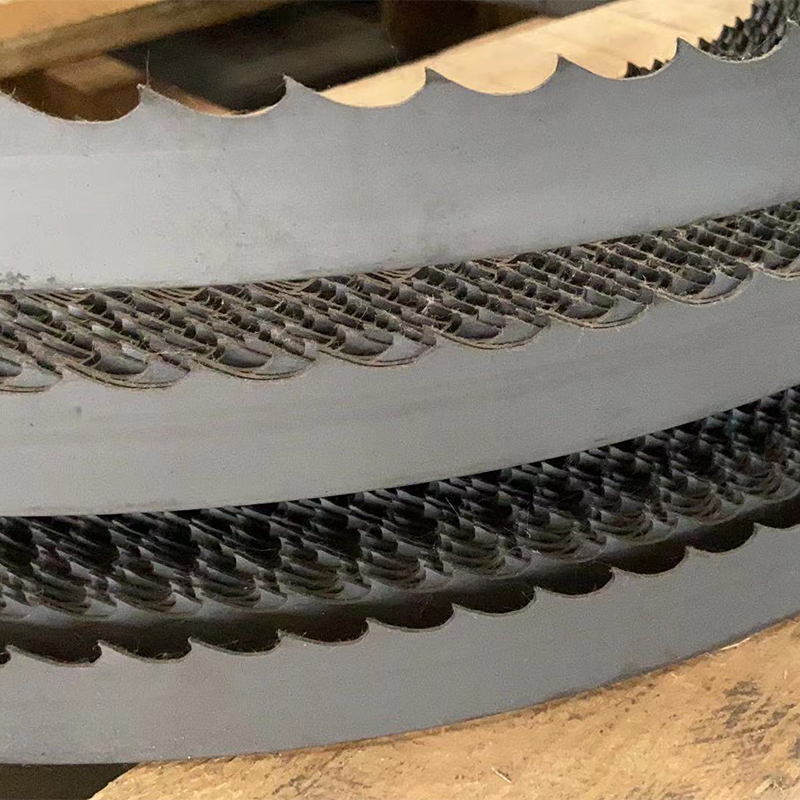
A bimetal band saw blade consists of three functional layers. M42/M51 applies only to the top layer:
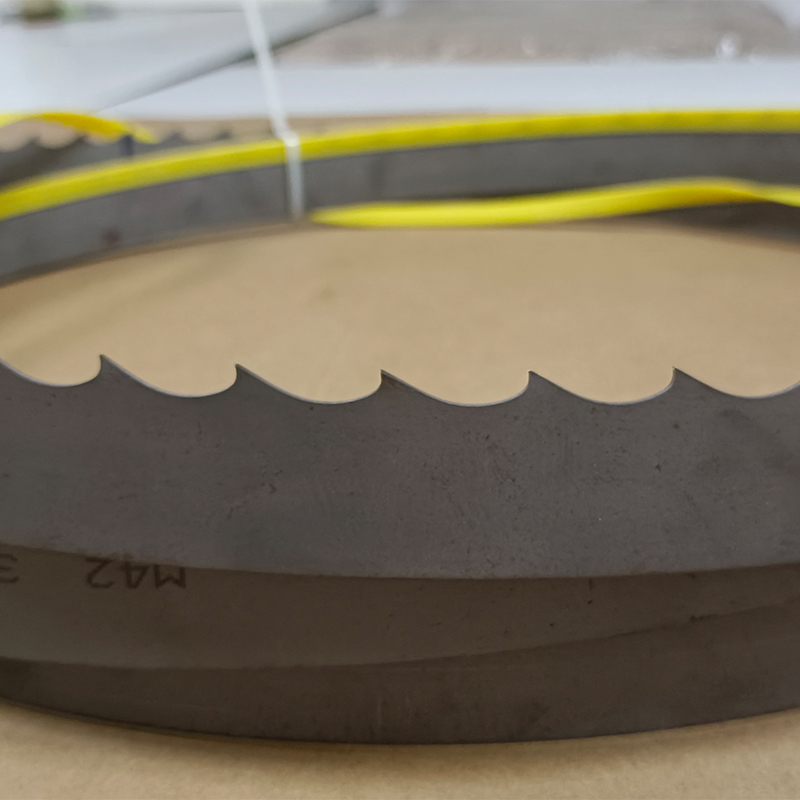
① Tooth tip (HSS cutting edge): Determines wear resistance and hot hardness. M42 or M51 is welded onto this layer. The tooth tip is bonded to the backing steel by electron-beam welding under high vacuum, creating a composite blade with both an extremely hard cutting edge and a flexible band body.
② Backing steel (spring steel/alloy steel band): Determines blade flexibility, fatigue resistance, and tensile strength. Common materials include spring steel and chromium-containing alloy steel backing. Backing quality directly affects the blade’s resistance to cracking on the wheel and is an independent design variable from the tooth-tip grade.
③ Tooth geometry (pitch, rake angle, gullet depth): Determines chip evacuation efficiency, cut surface quality, and application range. Variable pitch (e.g., 2/3, 3/4, 4/6, 5/8, 10/14 TPI) suppresses vibration; positive-rake hook teeth suit soft and thick materials; standard teeth around 0° suit general cutting and thin-wall materials.
Selection implication: If an M51 blade has tooth geometry that does not match your material thickness, or if the backing steel lacks sufficient fatigue resistance, the advantage of the high-cobalt tooth tip will be offset by premature band breakage or poor chip evacuation. M42/M51 is a “tooth-tip selection,” not the end point of “whole-blade selection.”
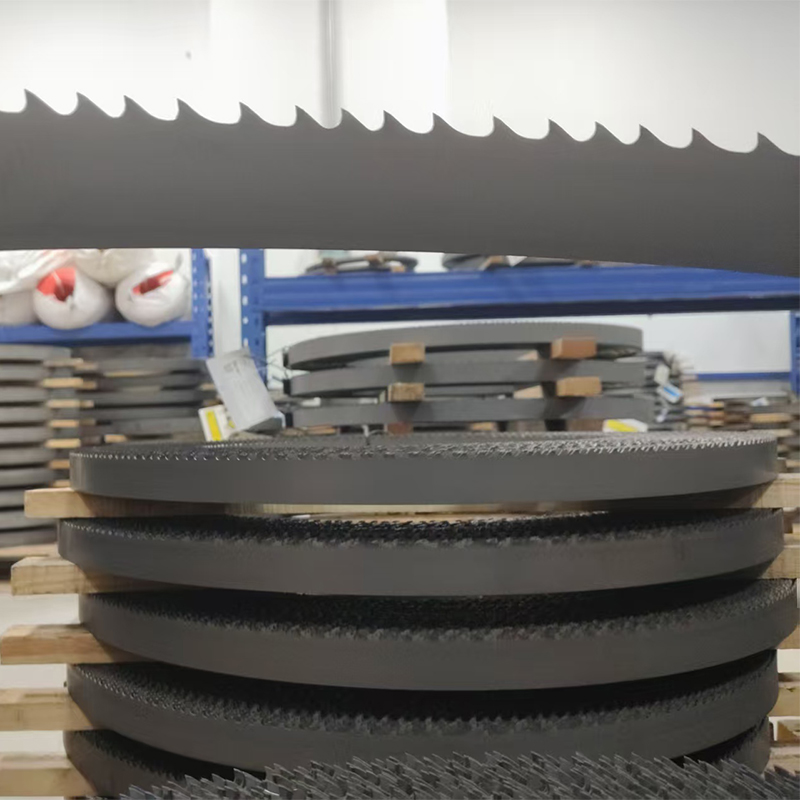
“Red hardness” refers to a cutting edge’s ability to maintain hardness at high temperature. During band saw cutting, friction and workpiece plastic deformation generate heat that is highly concentrated at the tooth tip. Once the tooth-tip temperature exceeds the alloy’s softening threshold, the edge plastically deforms and rounds. Cutting degrades from “shearing” to “pressing,” and blade life drops sharply.
M42’s softening threshold is approximately 600°C. Under conventional cutting conditions—such as carbon steel profiles, structural steel pipe, and aluminum, with feed and blade speed controlled within a reasonable range—the tooth-tip temperature stays well below this threshold, and M42 performs with no meaningful gap versus higher-grade alloys.
M51’s value appears in conditions where “heat generation exceeds what M42 can handle.” The most typical scenario is austenitic stainless steel: this material has a strong work-hardening tendency, and chips conduct heat poorly, so a large amount of heat is pushed back into the tooth tip rather than carried away by chips. Tooth-tip temperature rises rapidly. In addition, continuous carbon steel cutting on a production line where blade speed is raised to chase cycle time can also push the tooth tip into M51’s advantage zone. M51’s higher cobalt content and vanadium carbide distribution shift the softening window upward, allowing it to hold edge shape longer under these conditions.
M42 is the most widely used standard tooth material in bimetal band saw blades today. Its positioning is “sufficient for most shops most of the time.”
It is best suited for:
Solid, pipe, and profile cutting of carbon steel, structural steel, and low-alloy steel;
General cutting of aluminum, copper, and other nonferrous metals;
Mixed-incoming-material shops where one saw alternates between different materials;
Conditions involving intermittent cutting or impact loads—M42’s fracture toughness is generally better than that of higher-cobalt alloys, giving it an advantage against tooth-tip chipping caused by impact.
M42’s boundary: When material hardness approaches or exceeds 45 HRC, or when cutting austenitic stainless steel, nickel-based alloys, and other high-heat-generating materials, M42 tooth-tip wear accelerates significantly. In these cases, the life gain from upgrading to M51 usually covers its price premium.
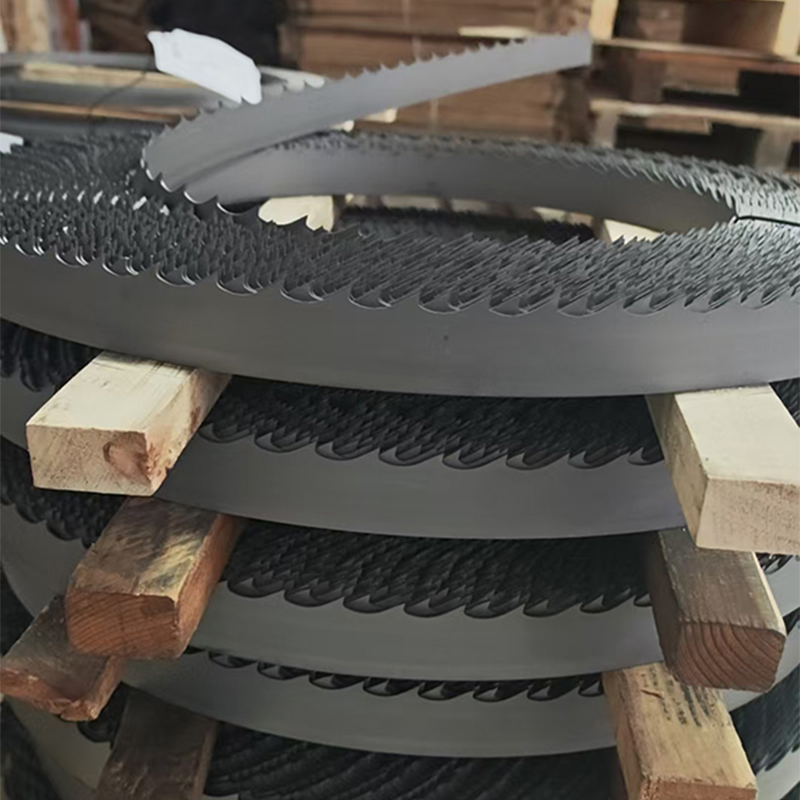
M51 is not a “better in every dimension” upgrade. It moves along the toughness–hot-hardness trade-off curve toward hot hardness. This means it suits cutting tasks where failure is driven primarily by thermal wear rather than impact chipping.
It is preferentially recommended for:
Cutting austenitic stainless steel (304, 316, etc.) plate, pipe, and solid stock;
High-alloy tool steel and die steel, with material hardness in the 45–50 HRC range;
Industrial cutting of titanium alloys, nickel alloys, and other difficult-to-machine materials;
Continuous production line operations: when every shift cuts stainless steel pipe or high-hardness alloys and M42’s blade-change frequency is already affecting cycle-time economics, M51’s long-life value becomes real.
M51’s boundary: If you are cutting mild steel, aluminum, or thin-wall profiles with conservative feed rates, the tooth-tip temperature may never reach M42’s softening point. In that case, M51’s extra hot hardness is not “activated”—the additional cost will not translate into a visible life difference.
The target keywords cover meat and bone saw blades, woodworking saw blades, carbide saw blades, and band knives. However, the dominant material logic in these categories belongs to different technology tracks from M42/M51 and cannot be conflated.
Meat and bone saw blades are predominantly made of food-grade carbon steel/alloy steel. Cgoodsaws’ frozen meat/bone blades use food-grade carbon steel such as ASTM 1075, with hardness around 45 HRC, meeting the food industry’s requirements for hygiene, corrosion resistance, and mechanical fatigue performance. Food-grade stainless steel blades are used in corrosion-sensitive scenarios, such as slaughtering and meat-processing lines that require frequent cleaning. In this category, M42/M51 bimetal tooth materials appear more often in reinforced specifications for cutting frozen hard bone or highly abrasive materials, rather than as the default choice for ordinary fresh meat portioning.
Woodworking saw blades sit at two ends: carbon steel and carbide-tipped teeth. Carbon steel blades cover softwood and general woodworking; carbide-tipped saw blades (carbide saws) are used for hardwood, composites, exotic woods, and other highly abrasive materials, with long life and smooth cuts as the core selling points. The selection logic for woodworking band saw blades is closer to “surface quality + wear resistance” than to metal cutting’s “hot-hardness threshold” logic.
“Band knife” is a colloquial catch-all term for band saw blades and covers all the above categories. When you see “M42 band knife” or “M51 band knife” in search or procurement contexts, the default reference is bimetal band saw blades for metal cutting. If the application is meat/bone or woodworking, you must verify whether the backing steel, tooth geometry, and hygiene/precision standards match.
Rather than asking “Which is better, M42 or M51?”, use the following sequence to narrow the choice:
Step 1: Check material hardness. Material hardness ≤ 45 HRC, mainly carbon steel and nonferrous metals → M42 is the starting point. Material hardness in the 45–50 HRC range, or involving stainless steel and high-alloy steel → include M51 in the primary evaluation.
Step 2: Check the heat-generation pattern. Intermittent cutting, thin wall, low feed rate → tooth-tip temperature is unlikely to accumulate, and M42’s hot hardness is usually sufficient. Continuous production line cutting, thick solid stock, or raising blade speed to improve cycle time → sustained high temperature is the dominant failure factor, and only then does M51’s high-cobalt tooth tip deliver quantifiable returns.
Step 3: Check the failure mode. If the old blade fails by tooth-tip rounding and wear, upgrading to M51 is the right direction. If failure is tooth-tip chipping or band breakage, the problem is more likely in tooth geometry, feed parameters, or backing steel. Simply increasing tooth-material cobalt content may not solve it—M42’s toughness may actually be more suitable.
Step 4: Calculate blade-change cost. M51 has a higher unit price than M42. Upgrading is justified only when M51’s life extension covers the price difference and the reduced downtime for blade changes has a real impact on output. For low-load, non-continuous cutting scenarios, M42’s cost-effectiveness advantage is often decisive.
Cgoodsaws’ product matrix covers applications from bimetal industrial cutting to food-grade meat and bone blades. The following directions are mapped by task:
Metal cutting (M42 / M51 bimetal band saw blades): Cgoodsaws supplies bimetal band saw blades with M42 and M51 tooth materials, covering common widths and tooth pitch configurations for carbon steel, alloy steel, stainless steel, and other materials. For mixed-incoming-material shops or metalworking scenarios with a low stainless steel share, the M42 series offers a balance of versatility and toughness; for production lines dominated by austenitic stainless steel and high-alloy steel, the M51 series is a more targeted hot-hardness upgrade.
Meat/bone and food cutting: Cgoodsaws’ frozen meat/bone band saw blades use food-grade carbon steel (such as ASTM 1075 / C75s / SK5), with hardness around 45 HRC and common 3/4 TPI pitch, suitable for slaughtering, meat processing, and frozen cutting. For specifications requiring food-grade stainless steel or reinforced tooth tips, further matching can be made based on specific hygiene standards and material hardness.
Woodworking and general cutting: Cgoodsaws offers carbon steel and bimetal woodworking band saw blade options for softwood, hardwood, and general woodworking cutting. For hardwood and highly abrasive materials, carbide-tipped saw blades are the direction for longer life.
Selection advice: Before finalizing M42 or M51, provide Cgoodsaws with three pieces of information: the material being cut and its hardness, the cutting method (intermittent/continuous, feed parameters), and the failure mode of the current blade. These three items point to the correct product more reliably than simply choosing “one grade higher in M number.”
Is M51 always longer-lasting than M42?
Not necessarily. M51’s advantage comes from higher hot hardness. The life difference appears only when cutting conditions actually push the tooth tip into M42’s softening range. In mild steel, aluminum, or low-load intermittent cutting, M42’s life may be comparable to M51’s, with better toughness and lower cost.
Can M42 and M51 blades be used interchangeably?
They can be installed interchangeably if physical dimensions (length, width, thickness) and tooth geometry match. But “it fits” does not mean “it is suitable.” If the material or conditions require M51’s hot hardness, switching back to M42 will increase blade-change frequency; if the conditions do not generate heat, switching to M51 may incur unnecessary cost.
Should food-grade meat and bone blades use M42 or M51?
The primary standard for meat and bone blades is food-grade material compliance and hygienic design, not the HSS grade of the tooth tip. Cgoodsaws’ frozen meat/bone blades mainly use food-grade carbon steel (ASTM 1075, etc.). For reinforced requirements such as frozen hard bone or highly abrasive materials, evaluate whether bimetal or special tooth-material specifications are needed. Directly applying metal-cutting M42/M51 selection logic to food applications is inappropriate.
When cutting stainless steel, how should M42 and M51 be chosen?
First look at the stainless steel type and cutting continuity. Austenitic stainless steel (304/316) generates concentrated heat under continuous or higher blade speeds, so M51’s hot-hardness advantage is more likely to translate into life. For small-batch, intermittent cutting of thin-wall stainless steel with conservative feed, M42 can still serve as a starting point, but monitor tooth-tip wear; if rounding is too fast, upgrade to M51.
How large is the price difference between M42 and M51?
M51’s unit price is usually higher than M42, but the difference varies by width, tooth pitch, purchase volume, and supplier. The decision should not rely only on price per meter; compare cost per cut: divide M51’s life extension by the price difference to judge whether the upgrade is economically justified.
Have questions about what we do? Interested in our product or becoming a partner? The first step is to get in touch with us. Head to our Contact Page and connect with the office in your area.
Copyright © 2017-2025 Hongsheng Saws Manufacturing Co., Ltd. All Right Reserved.
