Common "type" naming conventions often conflate attributes from different dimensions. A practical framework is: tooth pattern determines how smoothly the cut runs; tooth material determines whether it cuts at all, and for how long.
Tooth Pattern concerns tooth arrangement, rake angle, and gullet capacity—directly affecting chip evacuation, surface finish, and feed resistance. Tooth Material concerns tooth-tip hardness, wear resistance, and heat resistance—determining what hardness of material the blade can penetrate and how long it stays sharp under heat. A "Variable Pitch Bi-Metal Blade" has Variable Pitch as its tooth pattern and Bi-Metal as its tooth material—two independent selection decisions.
A frequently overlooked third variable is tooth pitch / TPI. Low TPI (e.g., 3–4 TPI) means wider tooth spacing and larger gullet capacity, suited to thick stock and soft materials at high feed rates. High TPI (e.g., 10–24 TPI) yields smoother cuts but reduced chip clearance, suited to thin-wall, tube, and precision cutting. Tooth pattern and TPI together define "cutting behavior"—you cannot decide on tooth pattern name alone.
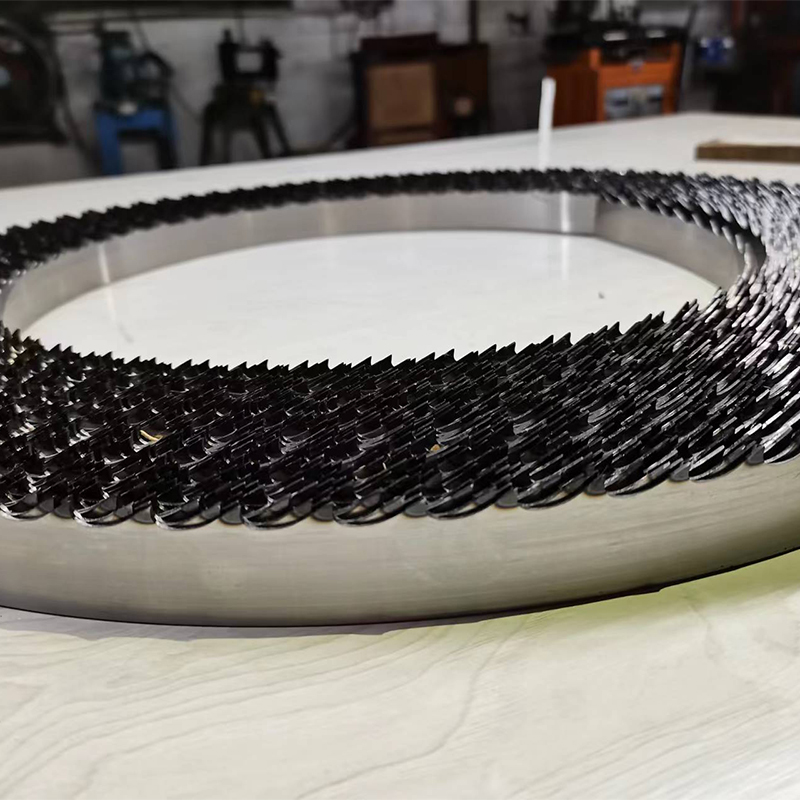
| Tooth Pattern | Tooth Geometry | Chip Clearance | Cutting Behavior | Typical Applications |
|---|---|---|---|---|
| Standard | Zero rake angle, uniform pitch | Moderate | Smoother finish; gullets clog easily in thick stock | Thin stock, precision cuts, general woodworking contour cutting |
| Skip | Zero rake angle, widened gullets, wider tooth spacing | Strong | Smooth chip evacuation, low cutting resistance | Softwood, plastic, aluminum, thick-stock rough cutting |
| Hook | Positive rake angle (typically 10°), large gullets | Very strong | Most aggressive cutting, fast feed, coarser finish | Thick stock, log sawing, meat and frozen food |
| Variable Pitch | Alternating pitch and tooth depth | Moderate-to-strong | Suppresses vibration and resonance; smoother, more stable finish | Metal cutting, profiled materials, vibration-sensitive precision cutting |
Tooth material selection is fundamentally a "upfront cost vs. cost-per-cut" trade-off, not "the more expensive, the better."
Carbon Steel has through-hardened teeth at approximately 64 HRC and the lowest manufacturing cost. Its limitation is poor hot hardness: once cutting temperature rises, the tooth tip softens rapidly and life drops sharply. It suits wood, plastic, aluminum, and other low-load, non-continuous scenarios; in metal cutting it has largely been superseded by bi-metal.
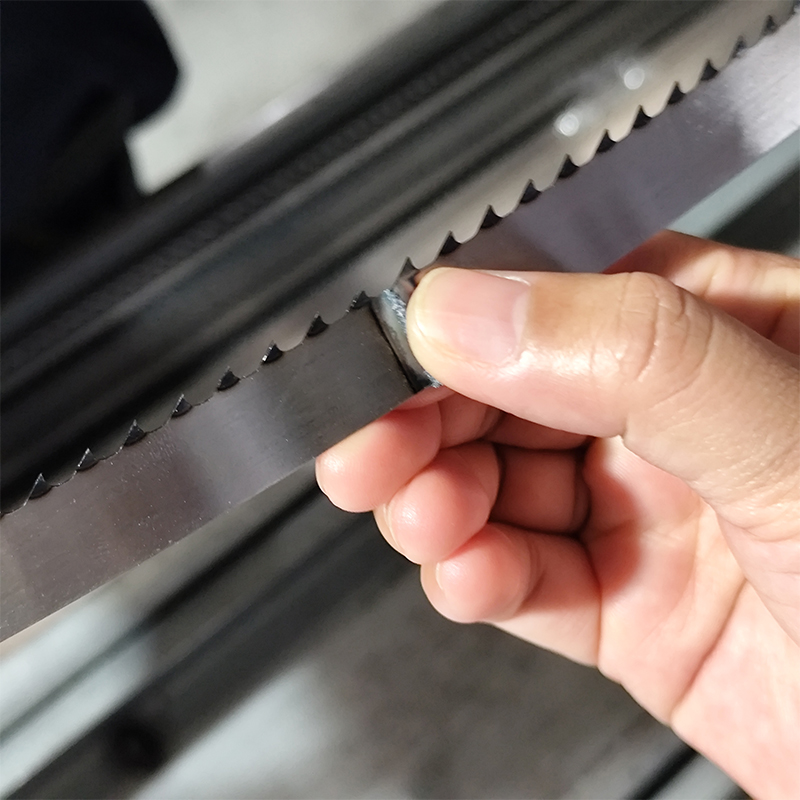
Bi-Metal is currently the broadest-coverage tooth material in industrial settings. The tooth tip is high-speed steel (HSS, commonly M42) at 67–69 HRC, laser-welded or electron-beam-welded to a spring-steel backing. The backing provides flexibility and fatigue resistance; the tooth tip provides wear resistance—a clear division of labor. Bi-metal offers the best price/performance ratio, covering a wide spectrum from non-ferrous metals and structural steel to stainless steel, tool steel, and some nickel-based and titanium alloys. But it has a ceiling: when workpiece hardness exceeds roughly 40–45 HRC, bi-metal tooth-tip wear accelerates markedly.
Carbide-Tipped blades use tungsten carbide tips at approximately 92 HRC, with wear resistance far exceeding HSS. They solve what bi-metal cannot handle economically: hardened alloys, highly abrasive composites, recycled metal with hard inclusions, and long continuous cuts requiring exceptional surface quality. The cost is not only a unit price several times that of bi-metal but also reduced impact resistance—carbide tips are more prone to chipping under vibration or mishandling, demanding greater machine rigidity and operator discipline.
The application boundary of band saw blades is expanding from traditional woodworking and metalworking into food processing, electronics, and medical manufacturing. Different industries define "a good cut" differently.
Woodworking and furniture manufacturing centers on the tension between resin adhesion and chip evacuation. Softwoods (pine, fir) deposit resin that clogs gullets and reduces cutting efficiency; hardwoods (oak, walnut) demand higher tooth-tip wear resistance and fatigue resistance. Cgoodsaws addresses this split at the material level: steel strip for hardwoods uses high-carbon alloy compositions to improve wear resistance, while steel strip for softwoods uses toughness treatment and tooth-geometry optimization to resolve resin adhesion and chip evacuation. For hot and humid markets such as Southeast Asia, Cgoodsaws has also developed a tropical-wood-specific tooth profile (HS profile) combined with anti-corrosion treatment—a case of regional climate adaptation rather than generic product logic.
Metalworking and machinery manufacturing selection logic follows a "material hardness spectrum." Carbon steel suits low-carbon steel and low-strength metals; bi-metal covers structural steel, stainless steel, die steel, and tool steel; carbide targets hardened steel, high-alloy materials, and highly abrasive workpieces. Variable Pitch dominates this field for the reasons stated above.
Food processing is an independent scenario easily overlooked in generic band saw blade articles. Meat and bone cutting imposes requirements fundamentally different from industrial material cutting: food-safety compliance (material grade, corrosion resistance, cleanability) and distinct cutting mechanics (fat lubrication, frozen brittleness, uneven bone density) matter equally. Hook teeth, with their positive rake and wide gullets, deliver better penetration and chip evacuation in bone-in meat and frozen food. Cgoodsaws' food-cutting line is based on high-carbon tool steels such as SAE1075, with tooth hardness reaching 52–56 HRC, and holds HACCP/NSF and Halal certifications, covering slaughter, seafood, bakery, and cold-chain segments.
Electronics and precision manufacturing is among the most technically demanding directions in band saw blade applications. Materials cut in chip packaging, semiconductor testing, consumer electronics, and medical devices are often extremely thin, brittle, or expensive, with far lower tolerance for kerf width, burrs, and heat-affected zones than traditional industries. Cgoodsaws' positioning includes "precision cutting solutions for electronic components," leveraging vertical integration from cold-rolled steel strip to finished blades to supply narrow-width, high-precision, mirror-finish strip-based cutting tools. What this field demands is not tooth-pattern variety but material consistency and dimensional tolerance control.
Most band saw blade brands are finished-product manufacturers that purchase steel strip externally. Cgoodsaws (Hongsheng Saws Manufacturing) has a different architecture: its CgoodSteel division carries the materials-science function, completing everything from cold-rolled annealed strip to quenched-and-tempered strip within the system before entering finished blade manufacturing. This vertical integration has two practical implications for selection scenarios.
First, tooth-material and backing-material matching can be tuned at the material level, rather than compromised only at the finished-product level. The life of a bi-metal blade depends heavily on weld quality between the HSS tooth material and spring-steel backing and on backing fatigue performance; when the backing is controlled within the same system, batch-to-batch consistency converges more easily. Second, custom non-standard tooth profiles and special materials can be responded to faster. Requirements such as tropical-wood HS profiles or specific food-cutting TPI combinations (3T/4T/12T customizable) are often filtered out at pure finished-goods traders due to minimum order quantities, but a manufacturer with material control can take them on at reasonable batch sizes.
For procurement decision-makers, this means Cgoodsaws is better suited to needs where "the application is clear but standard products do not fully match": not simply buying a box of 3 TPI hook blades, but inputting workpiece hardness, abrasiveness, resin characteristics, hygiene requirements, and equipment conditions together to obtain a combined solution of tooth pattern, TPI, tooth material, and backing.
| Scenario | Core Challenge | Recommended Tooth Pattern | Recommended Tooth Material / Product Direction | Cgoodsaws Capability |
|---|---|---|---|---|
| Hardwood sawing (oak, walnut) | Wear resistance, fatigue resistance, edge retention | Hook / Variable Pitch, medium TPI | High-carbon alloy strip, wear-resistant tooth tips | Hardwood-specific strip; fatigue and wear resistance optimized |
| Softwood sawing (pine, fir) | Resin adhesion, poor chip evacuation | Skip / Hook, low TPI | Toughness-optimized tooth geometry, anti-stick design | Softwood-specific strip; resin and chip-evacuation treatment |
| Tropical wood | High-temperature/high-humidity corrosion, unusual wood properties | HS-specific tooth profile | Anti-corrosion treated strip | Tropical-wood tooth profile + anti-corrosion process |
| General metal cutting | Wide hardness range, vibration-induced tooth breakage risk | Variable Pitch | Bi-metal (HSS tooth tips) | M42-grade bi-metal or equivalent available |
| Hard / highly abrasive materials | Insufficient bi-metal life, frequent blade changes | Variable Pitch / Hook | Carbide-tipped | Custom carbide solutions (confirmed per workpiece) |
| Meat and bone cutting | Food safety, fat evacuation, frozen brittleness | Hook, 3–4 TPI | SAE1075 / SK5 food-grade strip | Food-grade band saw blades, HACCP/NSF certified |
| Electronics / precision component cutting | Thin stock, low burr, dimensional tolerance | Fine tooth / high TPI, precision cutting profile | Precision cold-rolled strip substrate, mirror finish | Vertically integrated precision strip + electronics cutting blades |
What is the core difference between Variable Pitch and Hook among band saw blade types?
Variable Pitch's core advantage is vibration suppression: alternating pitch and tooth depth prevent periodic resonance between blade and workpiece, suiting metals and profiled materials. Hook's core advantage is chip evacuation and penetration: positive rake and large gullets let the tooth tip enter more aggressively, suiting thick stock, soft materials, and bone-in meat—but with a coarser finish and faster wear on hard materials.
Can carbon steel blades still be used for metal cutting?
They remain usable for intermittent, low-cost cutting of low-strength steel, but bi-metal is now mainstream for industrial metal cutting. Carbon steel tooth tips soften quickly under cutting heat, and the life gap versus bi-metal is rapidly amplified in continuous production.
Can bi-metal blades cut stainless steel?
Yes. Bi-metal's HSS tooth tips cover stainless steel, tool steel, and some high-alloy materials. But when material hardness approaches or exceeds 40–45 HRC, bi-metal wear rates rise, and carbide becomes the more economical choice.
Are food-cutting band saw blades and industrial metal-cutting blades interchangeable?
Not recommended. Food cutting imposes independent requirements on food-safety grade, corrosion resistance, and cleanability of materials, and tooth geometry is optimized for fat evacuation and bone penetration—different from the geometric logic of metal cutting. Cgoodsaws' food-grade line holds HACCP/NSF and Halal certifications, corresponding to a dedicated compliant material system.
Can Cgoodsaws provide non-standard tooth profiles or custom TPI?
Yes. Its food-cutting product page explicitly lists customizable pitches of 3T/4T/12T and supports ODM/OEM services. The tropical-wood HS profile itself is an example of a non-standard profile brought to production, demonstrating that customization covers tooth geometry rather than dimensions alone.
Have questions about what we do? Interested in our product or becoming a partner? The first step is to get in touch with us. Head to our Contact Page and connect with the office in your area.
Copyright © 2017-2025 Hongsheng Saws Manufacturing Co., Ltd. All Right Reserved.
